


BENTHOBS

BenthOBS :
The benthic macrofauna observation network (BenthOBS) was established in 2019. It is a National Observation Service (SNO) currently in the “incubation” phase and is part of the Coastal and Marine Research Infrastructure IR-ILICO.
BenthOBS is a macrozoobenthos observation network that brings together the human resources, technical facilities and expertise of 12 partners from universities, the CNRS, Ifremer and the French National Museum of Natural History (MNHN).
In a context of global change affecting all the world’s oceans, medium- and long-term time series make it possible to identify ongoing changes in benthic communities and improve our understanding of them, particularly in coastal environments. These changes affect species diversity within communities and the functioning of marine ecosystems.
The objectives of BenthOBS are to :
Understand the temporal trajectories of benthic macrofauna communities and characterize their functional dynamics ;
Compare BenthOBS data with existing macrozoobenthos data from other observatories (the ILICO Benthos database) and spatiotemporal monitoring programmes (WFD, MSFD) ;
Combine BenthOBS data with data from other National Observation Services monitoring water-column dynamics (COAST-HF, SOMLIT) and pelagic communities (SOMLIT, PHYTOBS) ;
More broadly, in a context of well-documented terrestrial biodiversity loss, acquire taxonomic and ecological knowledge of coastal marine species in mainland France, including their numbers, identity and dynamics.
At the national level, BenthOBS is hosted by the Laboratory of Oceanology and Geosciences (LOG, Joint Research Unit UMR 8187). The national coordinators are Vincent Bouchet (LOG, University of Lille, Université du Littoral Côte d’Opale, CNRS) and Nicolas Desroy (LER-CRESCO, Ifremer-MNHN).
BenthOBS in La Rochelle :
The LIENSs laboratory samples three stations twice a year : in early spring (March–April) and at the end of summer (September–October).
The stations are located at Boyardville in Marennes-Oléron Bay, at Pointe d’Arçay in the Pertuis Breton, and in the Pertuis d’Antioche (Antioche / SOMLIT / PHYTOBS). The data collected cover benthic macrofauna species richness, sediment grain size, sediment organic matter content and sediment CHN composition (carbon, hydrogen and nitrogen).
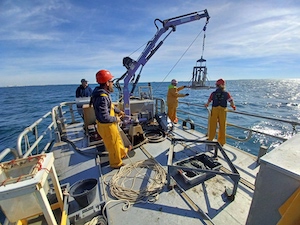
Samples are collected using a Van Veen or Smith-McIntyre grab aboard L’Estran, the research vessel operated by La Rochelle University (L’Estran).


BenthOBS team at LIENSs
Jérôme Jourde, CNRS Research Engineer : [Scientific coordinator]
Philippe Pineau, CNRS Research Engineer
Fabien Aubert, COHABYS ADERA Research Engineer
Last updated : February 2021]